Ultra-high power and wide spectrum Master Source Power Amplifier (MSPA) light sources

All standard products

Description

Master Source Power Amplifier (MSPA) devices are small-sized wide-spectrum light sources that utilize concepts similar to those used in the well-known Master Oscillator Power Amplifier (MOPA) configuration – the radiation of a highly stable low-power light source is boosted by a power amplifier, thus obtaining very high optical powers. The difference is that in the MSPA the master source is a superluminescent diode (SLD). The power amplifier is an optical booster spectrally matched to the master SLD. This design has a number of advantages over a light source based solely on an SLD. The main advantages are that the optical power can be increased to the levels not achievable with a sole SLD, and that the sensitivity to optical feedback (inherent to all high-power ASE sources, including SLDs) can be reduced. Besides, both the master SLD and the booster operate at lower drive currents, which significantly increases the lifetime and makes MSPA sources more reliable. Another important advantage is that the MSPA design does not result in an increase in relative intensity noise (RIN). The level of RIN for an MSPA source is comparable to that of single-frequency diode lasers and ranges from −135 to −145 dB/Hz.

We offer four standard models of MSPA sources, with a central wavelength of 800, 840, 850, and 970 nm.

Devices at other wavelengths are available upon request. Please contact us at enquiries@sldsources.com for more details.

When choosing a product, consider the following distinctive features of the devices:

  • MSPA840.40-50 is a model with the widest optical spectrum (up to 40 nm) and an output optical power of 50 mW. The emission spectrum of MSPA840.40-50 has a two-hump shape with a “saddle” in the region of 840 nm (see examples). The RIN is about −135 dB/Hz.
  • MSPA850.12-100 is suitable for applications requiring the highest possible optical power (up to 100 mW). Spectrum width (FWHM) is around 12 nm in this case. MSPA850.12-100 has a “bell-shaped” optical spectrum and the lowest RIN (typically −145 dB/Hz), comparable to the RIN of single-frequency diode lasers.

Examples of RIN spectra (MSPA840.40-50 – red, MSPA850.12-100 – blue)

Examples of RIN spectra (MSPA840.40-50 – red, MSPA850.12-100 – blue)

MSPA devices are highly polarized. The fiber used inside the device is a standard PANDA PM. All MSPAs are supplied with a 1 m long PM optical cable terminated by FC/APC connectors. The main polarization is aligned to the slow axis of the fiber, and to the key in FC/APC connectors.

MSPA devices are Class 3B lasers. They are designed for integration into customer equipment, but can also be used as stand-alone light sources. All MSPA sources have an INTERLOCK feature which can be enabled/disabled by the software that comes with the devices. Users must ensure that all safety features required by laser safety regulations are incorporated when MSPA is used as a stand-alone light source.

Features

  • Record high output optical power, up to 100 mW
  • Low coherence
  • Low sensitivity to optical feedback
  • Four models in the spectral range of 790 – 970 nm
  • Low relative intensity noise (RIN): −135 to −145 dB/Hz
  • Stable polarized output
  • Compact design
  • USB control interface
  • Output control by TTL pulses (turning on/off)
  • Easy integration into customer equipment

Applications

  • Spectroscopy and interferometry of various types
  • Testing of optical components
  • High brightness incoherent illumination

Specifications

Below are the specifications of standard models of MSPA light sources.

Optical specifications

Table 1

Parameter Units MSPA800.10-40 MSPA840.40-50 MSPA850.12-100 MSPA970.15-70
Central wavelength nm 800 840 850 970
Spectrum width (FWHM) nm 10 40 12 15
Output optical power mW 40 50 100 70
Output PER1 dB 15 (typ.) 15 (typ.) 15 (typ.) 15 (typ.)
RIN, 0.009 – 2 MHz dB/Hz −135 −135 −145 −135
Long-term optical power stability2 % < 1 < 1 < 1 < 1
Fiber type - PANDA PM 850
Output optical connector - FC/APC with narrow key
PC connection port - USB USB USB USB
1 Measured at the output of the supplied optical cable
2 After a 30-minute warm-up period

Electrical, environmental, and mechanical specifications

Table 2

Parameter Units MSPA840.40-50 and MSPA850.12-100
Supply voltage VDC +12
Supply current A 1.5
Operating temperature range °C −5 to +50
Storage temperature range °C −40 to +85
Relative humidity, non-condensing % < 90
Dimensions (W × H × D) mm 110 × 41 × 190
Weight kg 1.5

Typical performance examples

Below are typical performance examples for standard models of MSPA light sources.

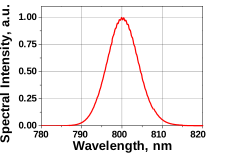
Model MSPA800.10-40

MSPA800.10-40: Emission spectrum in linear scale

MSPA800.10-40: Emission spectrum in linear scale


Model MSPA840.40-50

MSPA840.40-50: Emission spectrum in linear scale

MSPA840.40-50: Emission spectrum in linear scale

MSPA840.40-50: Emission spectrum in log scale

MSPA840.40-50: Emission spectrum in log scale

MSPA840.40-50: Coherence function (extended)

MSPA840.40-50: Coherence function (extended)

MSPA840.40-50: Coherence function (central peak)

MSPA840.40-50: Coherence function (central peak)

Model MSPA850.12-100

MSPA850.12-100: Emission spectrum in linear scale

MSPA850.12-100: Emission spectrum in linear scale

MSPA850.12-100: Emission spectrum in log scale

MSPA850.12-100: Emission spectrum in log scale

MSPA850.12-100: Coherence function (extended)

MSPA850.12-100: Coherence function (extended)

MSPA850.12-100: Coherence function (central peak)

MSPA850.12-100: Coherence function (central peak)

More detailed specifications

For more detailed specifications for the above part numbers please contact enquiries@sldsources.com.

Get in contact

Want help or have questions?

Contact us
To the Top